Tuesday, May 26, 2009

Maharaja Sawai Jai Singh II and Jantar Mantar

It was all very, very romantic. On a terrace watching the moon and the stars were a princess and a king. The question she asked was one that no Hollywood or Bollywood film script writer would have ever thought of putting into the mouth of any of his heroines. The question was, "How far away are these stars and the moon?" If the lover in the king was abashed by the question, so also was the astronomer in him. When the princess gently chided him for his ignorance, all thoughts of romance fled and he decided that he must find the answer to her question.

Astronomers were invited to his court for study and discussions and the king read all the treatises he could find on the subject. The Jantar Mantar (observatories) which the king built to gain her love and admiration still stand in New Delhi, Jaipur, Varanasi and Ujjain. Unfortunately, the one at Mathura was destroyed by building contractors who wanted the stones.

Maharaja Sawai Jai Singh (November 3, 1688-September 21, 1743) was ruler of the kingdom of Amber (later called Jaipur). He was born at Amber, the capital of the Kachwahas. He became ruler of Amber in 1699 at the age of 11 when his father Maharaja Bishan Singh died. The Mughal emperor Aurangzeb bestowed upon him the title of "Sawai" which meant one and a quarter times superior to his contemporaries. This title adorns his descendants even to this date.

Sawai Jai Singh was the first Hindu ruler in centuries to perform the ancient Vedic ceremonies like the Ashwamedha (1716) sacrifices — and the Vajapeya (1734) on both occasions vast amounts were distributed in charity.

Jai Singh’s observatories were called ‘Jantar Mantars’, which in Sanskrit roughly translates to ‘The Formula of Instruments’. The first one was built at Delhi in 1724, the second at Jaipur in 1734 and the other smaller ones at Mathura, Ujjain and Varanasi between 1732 and 1734. These monumentally grand, surrealistic structures, with their remarkable geometric shapes, are themselves the astronomical instruments, outfitted with drafting devices and grid indicators, and are so highly sophisticated that they are capable of exactly measuring planetary positions and reading time precise to one second. They were built with the assistance of the Bengali Pandit Vidyadhar Bhattacharya (also the engineer of Jaipur City), and are based on Ulugh Beg’s large 15th century instruments at Samarkhand. Although smaller, futuristic instruments like the telescope and newer-type of observatories in Paris and Greenwich were revolutionizing contemporary Europe, Jai Singh had more faith in the accuracy of his huge masonry structures.
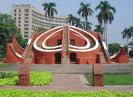
These days Jai Singh's observatories at Jaipur, Varanasi, and Ujjain are functional. Only the one at Delhi is not functional and that at Mathura disappeared long time ago.

He also himself designed some of the instruments, like the Samrat Yantra (a huge equinoctial dial), Ram Yantra (a cylindrical building with an open top and a pillar in its center), and Jai Prakash Yantra (a concave hemisphere), the Digamsha Yantra (a pillar surrounded by two circular walls), and the Narivalaya Yantra (a cylindrical dial).

Jai Singh’s greatest achievement was the construction of Jaipur city (known originally as Jainagara (in Sanskrit, as the 'city of victory' and later as the 'pink city' by the British by the early 20th century), the planned city, later became the capital as the Indian state of Rajasthan.

Jai Singh opened his observatories to the public in order to popularize astronomy. Today, Jai Singh’s Jantar Mantars are open to tourists and are well-worth a visit.

For these multiple achievements Sawai Jai Singh II is remembered even to this date, as the most enlightened king of 18th Century India.

Friday, May 15, 2009

Vedas - Most Ancient Religious Texts

The Vedas are the ancient scriptures or revelation (Shruti) of the Hindu teachings. They manifest the Divine Word in human speech. They reflect into human language the language of the Gods, the Divine powers that have created us and which rule over us.

The Vedas ("knowledge") are a large body of texts originating in Ancient India. They form the oldest layer of Sanskrit literature and the oldest sacred texts of Hinduism.

According to Hindu tradition, the Vedas are apauruseya ("not of human agency"), are supposed to have been directly revealed, and thus are called shruti ("what is heard"). Vedic mantras are recited at Hindu prayers, religious functions and other auspicious occasions.

The Vedas are the primary texts of Hinduism. They also had a vast influence on Buddhism, Jainism, and Sikhism. The Vedas contain hymns, incantations, and rituals from ancient India. They are among the most ancient religious texts still in existence. Besides their spiritual value, they also give a unique view of everyday life in India four thousand years ago.

The Vedas were compiled around the time of Krishna (c. 3500 B.C.), and even at that time were hardly understood. Scholars have determined that the Rig Veda, the oldest of the four Vedas, was composed about 1500 B.C., and codified about 600 B.C. It is unknown when it was finally committed to writing, but this probably was at some point after 300 B.C.

There are four Vedas:

The Rig-Veda:- The Rig-Veda Samhita is the oldest significant existent Indian text. It is a collection of 1,028 Vedic Sanskrit hymns and 10,600 verses in all, organized into ten books (Sanskrit: mandalas). The hymns are dedicated to Rigvedic deities. The hymns are dedicated to thirty-three different gods; these gods were, quite expectedly, nature gods. The most often addressed gods are Indra (rain god; king of heavens), Agni (fire god) and Rudra (storm god; the 'howler'). A sizeable chunk of the verses are also dedicated to Soma (the draught of immortality), which was a cool alcoholic brew made from the leaves of the soma plant and was drunk during sacrifices.

The Sama-Veda:- The Sama-Veda is the "Veda of melodies" or "Knowledge of melodies". The Sama-Veda or the wisdom of chants is basically a collection of samans or chants, derived from the eighth and ninth books of the 'original Veda', the Rig-Veda. These were meant for the priests who officiated at the rituals of the soma ceremonies – in full sway there could have as many as seventeen full rituals.
It is not surprising that the Sama-Veda is better known for the precise meter of its poetry than for its literary content. There are also painstaking instructions in Sama-Veda about how particular hymns must be sung; this is perhaps because great emphasis was put upon sounds of the words of the mantras and the effect they could have on the environment and the person who pronounced them.

The Yajur-Veda:- The Yajur-Veda or the wisdom of sacrifices lays down various sacred invocations (yajurs) which were chanted by a particular sect of priests called adhvaryu. They performed the sacrificial rites. This is very much a ritual based Veda for although there are a few hymns to various Gods the main stress is on the theory of the ritual. The Veda also outlines various chants which should be sung to pray and pay respects to the various instruments which are involved in the sacrifice.

The Atharva-Veda:- The Atharva-Veda Sahita has 760 hymns, and about 160 of the hymns are in common with the Rig-Veda. The Atharva-Veda (the wisdom of the Atharvans) is called so because the families of the atharvan sect of the Brahmins have traditionally been credited with the composition of the Vedas. It is a compilation of hymns but lacks the awesome grandeur which makes the Rig-Veda such a breathtaking spiritual experience. It is roughly equivalent to the western magic spells and has incantations for everything – from success in love to the realization of otherworldly ambitions.

Friday, May 8, 2009

Bailey bridge - World's highest bridge

The Bailey bridge is the highest bridge in the world. It is located in the Ladakh valley between the Dras and Suru rivers in the Himalayan Mountains. It was built by the Indian Army in August 1982. It is 30 meters (98 ft) long, and is at an altitude of 5,602 meters (18,379 ft) above sea level.

The Bailey bridge is a portable pre-fabricated truss bridge, designed for use by military engineering units to bridge up to 60 m (200 ft) gaps. It requires no special tools or heavy equipment for construction, the bridge elements are small enough to be carried in trucks, and the bridge is strong enough to carry tanks.

A bailey bridge is a prefabricated bridge used by combat engineers, which can be rapidly constructed on the battlefield. The system was devised by British engineer Sir Donald Bailey during World War 2, and consists of a basic diamond braced unit of welded steel, 3×1•5 m/10×5 ft square, which can be easily manipulated by a squad of six men and joined together to make complex bridging structures.

A large part of what made Bailey bridges as successful and unique as they were is the modular design, and the fact that it could be assembled with minimal aid from heavy equipment. Most, if not all, previous designs for military bridges required cranes to lift up the preassembled bridge and lower it into place. Finally, the modular design allowed engineers to build each bridge to be as long and as strong as needed, doubling or tripling up on the supportive side panels, or on the roadbed sections.

Each unit constructed in this fashion creates a single 10 ft (3 m) long section of bridge, with a 12 ft (4 m) wide roadbed.

For added strength several panels (and transoms) can be bolted on either side of the bridge, up to three. With three panels across and two high, the Bailey Bridge can support tanks over a 200 ft (60 m) span.

An astonishing feature of the Bailey bridge is its ability to be "launched" from one side of a gap. In this system the frontmost portion of the bridge is angled up with wedges into a launching nose and most of the bridge is left without the roadbed and ribands. The bridge is placed on rollers and simply pushed across the gap, using manpower or a truck or tracked vehicle, at which point the roller is removed (with the help of jacks) and the ribands and roadbed installed, along with any additional panels and transoms that might be needed.

The Bailey bridge was originally developed by the military to construct quickly across rivers in wartime. There's a lake to the right of the bridge and a hydroelectric dam to the left.

They are a bit noisy when you drive over them but they are very stable. There isn't much traffic here as it's almost at the end of a valley. Cars, trucks and even tanks can easily pass through them.

More to read : World's Highest Battle field, Chail - World's Highest Cricket Ground

Sunday, April 26, 2009

Key Dates of Indian Elections History


India, the world's largest democracy, holds a general election in April and May.Here is a timeline of key dates in India's election history:

1947- 1952

  • Shri Jawaharlal Nehru, one of the founding fathers of independent India, becomes the country's first prime minister. His appointment starts a long period of political dominance of the Congress party and the country's most powerful dynasty, the Gandhi-Nehru family.

1952- 1957

  • India held its first national elections under the Constitution in 1952, where a turnout of over 60% was recorded.
  • Shri Jawaharlal Nehru leads Congress to a clear victory in the country's first ever general election and began a second term as Prime Minister.

1957–1966

  • Prime Minister Nehru led the Congress to major election victories in 1957 and 1962
  • Nehru leads Congress and retains the prime ministership, which he held until his death in 1964.
  • From May 27, 1964 - January 24, 1966 Shri Gulzari Lal Nanda and Shri Lal Bahadur Shastri held the post of prime ministership for small periods.

1966-1977

  • Nehru's daughter Mrs. Indira Gandhi leads Congress to another victory and becomes the country's only female prime minister.
  • She wins another election victory in 1971 -- the year India trounced Pakistan in the third war between the two countries since 1947.

1975-1979

  • Mrs. Indira Gandhi imposes a State of Emergency, which critics says gave her near dictatorial powers.
  • Indira called for elections in 1977, only to suffer a humiliating electoral defeat at the hands of the Janata Party.
  • Shri Morarji Desai, an ageing supporter of Mahatma Gandhi's philosophies, becames the first non-Congress Prime Minister.
  • 28 July 1979 Morarji Desai  Dismissed by President following a no-confidence motion.
  • 28 July 1979, Shri Charan Singh formed an interim government. The Janata party had become intensely unpopular due to its internecine warfare, and the fact that it offered no leadership on solving India's serious economic and social problems.

1980-1984

  • Mrs. Indira Gandhi re-elected again, but is assassinated four years later by her Sikh bodyguards after a suppression of Sikh separatism that culminated in the storming of the Golden Temple.

1984-1989

  • Shri Rajiv Gandhi, Indira's son and a former commercial pilot, becomes India's youngest prime minister and leads Congress to victory.
  • Gandhi is voted out five years later after becoming embroiled in the Bofors scandal, a defence deal, of which he was posthumously cleared in 2004.

1989-1991

  • Power came to Rajiv Gandhi former finance and defence minister, Shri Vishwanath Pratap Singh. Singh led the Janata Dal coalition to a majority.
  • V.P. Singh resigned on 10 November 1990 because he started to implement the controversial Mandal commission report, to increase the quota in reservation for low caste Hindus and BJP protested these implementations, and took its support back.
  • Shri Chandra Shekhar  split to form the Janata Dal (Socialist) and came in power, supported by Rajiv's Congress. This new government also collapsed in a matter of months, when congress withdrew its support.

1991-1996

  • In the 1991 elections, Congress (I) won 244 parliamentary seats and put together a coalition, returning to power under the leadership of  Shri P. V. Narasimha Rao. This Congress-led government, served a full 5-year term.

1996-2004

  • The Bharatiya Janata Party (BJP) emerged from the May 1996 national elections as the single-largest party in the Lok Sabha but without enough strength to prove a majority on the floor of that Parliament.
  • Under Prime Minister Shri Atal Bihari Vajpayee   , the BJP coalition lasted in power 13 days.
  • With all political parties wishing to avoid another round of elections, a 14-party coalition led by the Janata Dal emerged to form a government known as the United Front. A United Front government under Shri H. D. Deve Gowda  lasted less than a year.
  • On April 21, 1997 Shri Inder Kumar Gujral  replaced Deve Gowda as the consensus choice for Prime Minister of a 16-party United Front coalition.
  • In November 1997, the Congress Party again withdrew support for the United Front. New elections in February 1998 brought the BJP the largest number of seats in Parliament (182).
  • On March 20, 1998, the President inaugurated a BJP-led coalition government with Shri Atal Bihari Vajpayee   again serving as Prime Minister.

2004-till date

  • The BJP loses to Congress despite presiding over healthy economic growth. Its "India Shining" campaign fails to resonate with voters.
  • Sonia Gandhi, the Italian-born widow of Rajiv Gandhi, leads a Congress victory, but steps aside to let Dr. Manmohan Singh  become prime minister, ending sniping about her nationality

List Of Prime Ministers of India


More articles to read:

Friday, April 24, 2009

Prehistoric India

The Indian prehistoric era is one of the most fascinating and intriguing eras to read about. Though there is speculation about when it originated, historians quote the approximate period from 200000 B.C to about 3500 - 2500 B.C. It is estimated that the first humans to set their foot in the Indian sub continent between 200000 B.C and 40000 B.C. Pre historic India has been divided into four major eras. These are: Stone Age, Paleolithic Era, Mesolithic Era and Neolithic Era. The Bronze Age is also mentioned here though it comes after these four eras. Further information about Indian prehistory is given below. 
Stone Age
The Stone Age was the era when early man used stones for functional and useful purposes. The Stone Age is further classified into three categories which are the Paleolithic Age, Mesolithic Age and Neolithic Age. These divisions have been made on the basis of the kind of stone tools that were used during these times. 
Paleolithic Age
The Paleolithic Age lasted till about 8000 B.C. In this age, man was essentially a food gatherer. He learnt to make weapons out of stones and also mastered the skill of hunting animals. The crude weapons were slowly carved properly and were made sharp and pointed. These special weapons were made by shredding the sides of a stone with a heavier stone. Man also learnt how to create fire and make use of it. He learnt to control fire, which helped him to improve his way of living. 
Mesolithic Age
The Mesolithic Age lasted from 8000 B.C - 4000 B.C. In this age the size of the groups grew to form small communities. The number of mouths to feed increased and needed constant nurturing for continuation. The tools improved and became more refined and sharp. There was a drastic change in the food and clothing of man. The tools were modified and now the sharp stones were attached to strong tree branches using ropes and vines. These new weapons or hand axes could be flung on animals from a safe distance. Apart from this, farming techniques were developed and man began to grow crops. Man also learnt to draw and paint and the evidence is found in the form of cave paintings found in India. 
Neolithic Age 
Neolithic (New Stone Age) settlements in the Indian sub-continent are not older than 4000 BC. The Neolithic Age lasted from 4000 B.C - 2500 B.C and is known as the last stage of the Stone Age era. The main features of this age were the finely flaked weapons and small tools made of stone that were used for day to day work. This age also saw domestication of cows, horses and other poultry and farm animals. Their products were used for dairy and meat items. The wheel, which was a very important invention, was created during this age. Shortly after this age around 1800 B.C, tools were made of copper and bronze and were used for many practical purposes.
Bronze Age
The Bronze Age is the era when metals were used and improvised for making tools and other weapons. This age came immediately after the Neolithic Age and aided in the development of the metallurgy industry. It came into being in 3500 B.C in the Middle East. The Bronze Age in India is roughly estimated to have begun around 3300 B.C. It almost coincided with the beginning of the Indus Valley Civilization. People living in Indus Valley produced bronze, copper and tin thus developing new techniques of metallurgy.
More articles to read:


Thursday, April 23, 2009

Charaka - Father of medicine

Charaka, sometimes spelled Caraka, born c. 300 BC in a Maga Brahmin family was one of the principal contributors to the ancient art and science of Ayurveda, a system of medicine and lifestyle thought to be developed about 5000 years ago in Ancient India. Acharya Charak has been crowned as the Father of Medicine

According to Charaka's translations health and disease are not predetermined and life may be prolonged by human effort and attention to lifestyle.

The following statements are attributed to Charaka: A physician who fails to enter the body of a patient with the lamp of knowledge and understanding can never treat diseases. He should first study all the factors, including environment, which influence a patient's disease, and then prescribe treatment. It is more important to prevent the occurrence of disease than to seek a cure.

These remarks appear obvious today, though they are often not heeded, and were made by Charaka, in his famous Ayurvedic treatise Charaka Samhita. The treatise contains many such remarks which are held in reverence even today. Some of them are in the fields of physiology, etiology and embryology. Charaka was translated into Persian and Arabic in the eighth century, and is still used today. Most of what is known about Indian medical science derives from this text and two others, the Susruta Samhita and the Ashtangahridaya Samhita.

Charaka was the first physician to present the concept of digestion, metabolism and immunity. According to him a body functions because it contains three dosha or humours, namely, bile, phlegm and wind. These dosha are produced when dhatus, namely, blood, flesh and marrow, act upon the food eaten.

For the same quantity of food eaten, one body, however, produce dosha in an amount different from another body. That is why one body is different from another. For instance, it is weightier, stronger, and more energetic.

Further, illness is caused when the balance among the three dosha in a human body is disturbed. To restore the balance he prescribed medicinal drugs. Although he was aware of germs in the body, he did not give them any importance.

Charaka also knew the fundamentals of genetics. For instance, he knew the factors determining the sex of a child. Agenetic defect in a child, like lameness or blindness, he said, was not due to any defect in the mother or the father, but in the ovum or sperm of the parents -an accepted fact today.

Charaka Samhita regarded disease as originating either inside the body or from outside. It also covers bodily structure and function, the cause, symptoms, and prognosis of disease, and the effect of disease on the body. Charaka describes more than 600 drugs of animal, plant, and mineral origin, along with formulas for medicines and instructions for making them.

Charaka also studied the anatomy of the human body and various organs. He gave 360 as the total number of bones, including teeth, present in the body. He wrongly believed that the heart had one cavity, but he was right when he considered it to be a controlling centre. He claimed that the heart was connected to the entire body through 13 main channels. Apart from these channels, there were countless other ones, some big and some small, which supplied not only nutrients to various tissues but also provided passage to waste products. He also claimed that any obstruction in the main channels led to a disease or deformity in the body.

However, there is nothing known about Charaka as a person. It is said that he was the son of a sage who travelled from place to place on foot to cure the suffering masses.

Related Article : Sushruta---Father of Surgery

Tuesday, April 21, 2009

Chanakya - Indian Machiavelli

One of the greatest figures of wisdom and knowledge in the Indian history is Chanakya. Chanakya (c. 350-283 BCE) was an adviser and a prime minister to the first Maurya Emperor Chandragupta (c. 340-293 BCE), and architect of his rise to power.

Chanakya, also known as Kautilya or Vishnugupta, was born in Pataliputra, Magadh (modern Bihar), and later moved to Taxila, in Gandhar province(now in Pakistan). He was a professor (acharya) of political science at the Takshashila University and later the Prime Minister of the Emperor Chandragupta Maurya. He is widely believed to be responsible for the creation of Mauryan empire, the first of its kind on the Indian subcontinent.

He is regarded as one of the earliest known political thinkers, economists and king-makers. He was the man to envision the first Indian empire by unification of the then numerous kingdoms in the Indian sub-continent and provide the impetus for fights against the Greek conqueror Alexander. In Jawaharlal Nehru's Discovery of India, Chanakya has been called the Indian Machiavelli.

His famous work called Arthashastra is a classic example of statecraft and politics and is read in Europe even today. It is arguably the first systematic book on economics. It discusses monetary and fiscal policies, welfare, international relations and war strategies in detail. It basically consists of the principles of politics and how the state works. An able ruler has to be a ruthless leader to make sure that the state works smoothly and efficiently. He believed in four ways Enticement, Sowing dession, Punishment or war. He was the master of shrewd act of diplomacy.

Another book attributed to Chanakya was Nitishastra which is also known as Chankya Niti. Many of his nitis or policies have been compiled under this book. Nitishastra is a treatise on the ideal way of life, and shows Chanakya's in depth study of the Indian way of life.

The legends associated with Chanakya are very interesting and provide a testimony of his greatness.

Legends:

• When Chanakya was born he had a full set of teeth, which is a sign that he would become a king or an emperor. But since he was born in a Brahmin family, it was considered inappropriate. Thus, his teeth were broken and it was predicted that he would make another person a king and rule through him.
• Even as a child, Chanakya had the qualities of a born leader. His level of knowledge was beyond children of his age.
• Chanakya was thrown out of the court of King Nanda as he was a blunt man and spoke his mind clearly. Chanakya swore he would take revenge.
• Chanakya comes across Chandragupta as a young child. Even at that age, he was a born leader and showed the qualities of an able Emperor. He was the guiding force behind Chandragupta and the vital person who made him an able Emperor.
• Chanakya adds poison in little amounts daily in Chandragupta's food in order to make him immune to poison, lest some enemy tries to poison him.
• However Chandragupta was unaware about this and once gave a little food to his wife who was in the ninth month of pregnancy. She didn't survive but Chanakya cut open her belly and took out the baby.
• This baby grew up to become an able emperor named Bindusara. He had a minister named Subandhu who did not like Chanakya. He told Bindusara that Chanakya had killed his mother.
• Without assessing facts, Bindusara confronted Chanakya. On knowing the whole story, he felt ashamed at his hasty actions and begged for forgiveness. He asked Subandhu to go and apologize and make Chanakya come back.
• Subandhu was very cunning and on the pretext of going to apologize to Chanakya, he killed him. Thus, ended the life of a great person like Chanakya just because of political rivalry.

His main philosophy was "A debt should be paid off till the last penny; An enemy should be destroyed without a trace". He seemed to have lived - and died - by his philosopy.

More to read : Sushruta---Father of Surgery, Bhaskaracharya
Related Posts Plugin for WordPress, Blogger...